
The Unsung Heroes of the Garden: A Complete Guide to Solitary Bees
When most people think of bees, they immediately picture the social honeybee, with its complex hives, queens, and honey production. However, the vast majority of bee species worldwide, including many found right here in Gauteng, are solitary bees. While they may not produce honey, solitary bees are arguably the most important pollinators in our local ecosystem and are essential for the success of both indigenous flora and home gardens.
At Lavender SA, we cultivate lavender specifically to support these vital insects. Understanding their biology and behavior is the first step in creating a truly thriving, biodiverse garden.
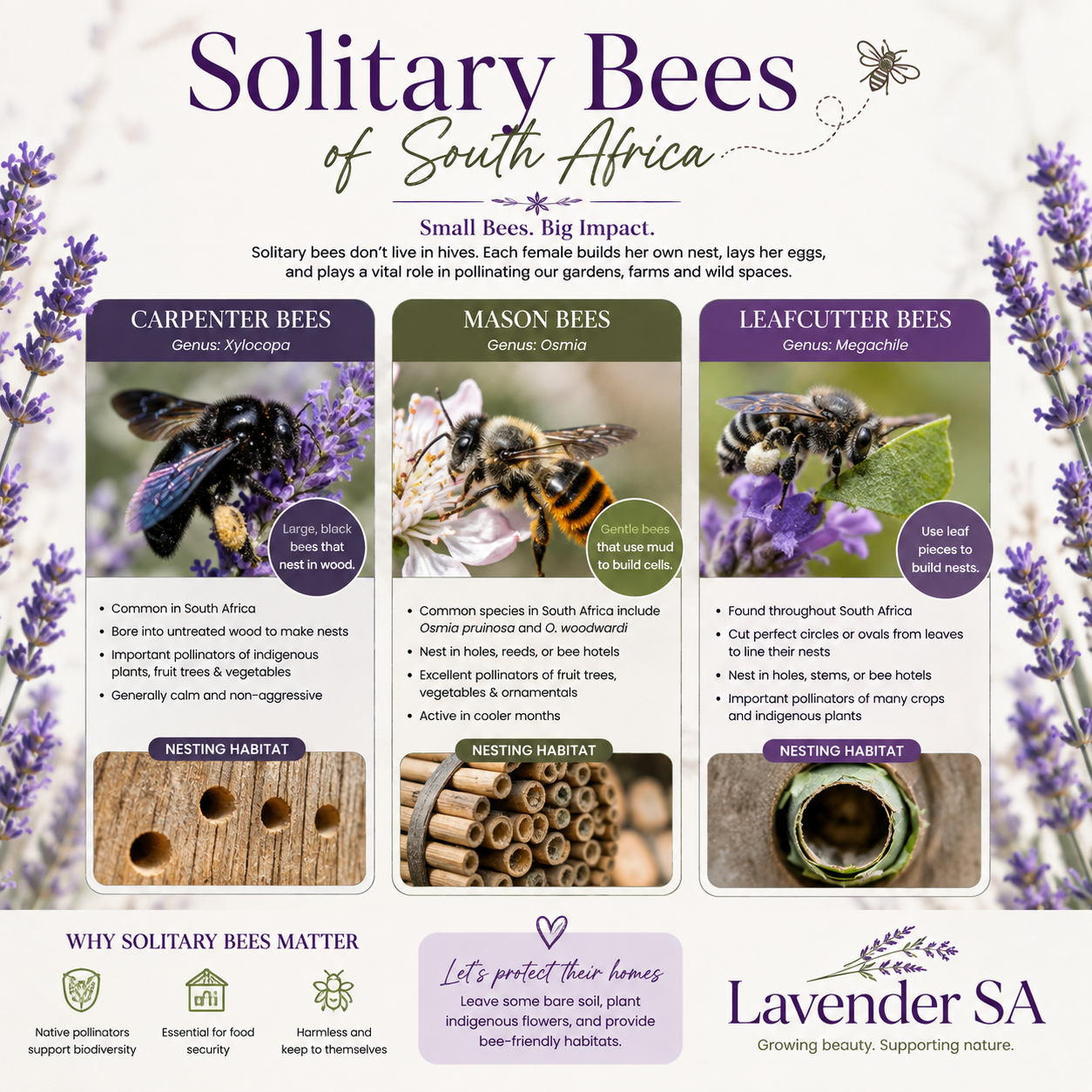
Image: Solitary bees, such as this Mason bee, carry pollen on their abdomens, making them highly efficient pollinators.
What Makes a Bee "Solitary"?
Unlike honeybees, solitary bees do not live in colonies. There is no queen, no worker caste, and no hive to defend. Each female solitary bee is entirely independent. She forages for her own food, builds her own nest, and lays her own eggs. Once she provisions a nest cell with pollen and nectar for her offspring, she seals it and moves on to build the next. The adult bees typically live for only a few weeks, but their impact on the environment is immense.
Why Solitary Bees Are Superior Pollinators
From an agricultural and horticultural perspective, solitary bees are often far more efficient pollinators than honeybees. This comes down to their anatomy.
Honeybees have specialized structures called "corbiculae" (pollen baskets) on their hind legs. They meticulously pack pollen into these baskets to take back to the hive, meaning very little pollen is transferred to the next flower they visit.
Solitary bees, however, carry pollen on specialized hairs (scopa) located on the undersides of their abdomens or legs. Because they do not pack the pollen away, they are "messy" pollinators. As they move from flower to flower, large amounts of loose pollen rub off onto the stigmas of the plants. Studies have shown that a single solitary mason bee can do the pollination work of up to 100 honeybees.
Common Solitary Bee Species in South Africa
South Africa is home to a rich diversity of solitary bees. Here are the most common types you are likely to encounter in a Pretoria East garden:
- Carpenter Bees (Xylocopa species): These are large, robust, and often mistaken for bumblebees. They are named for their nesting habit; the females use their powerful mandibles to bore perfectly round holes into dead wood, bamboo, or reeds to lay their eggs. They are excellent pollinators for larger flowers.
- Mason Bees (Osmia species): Mason bees are smaller, metallic, and incredibly docile. They nest in pre-existing hollow tubes, such as hollow plant stems or the holes in our premium bug hotels. True to their name, they use mud to construct partitions between their nest cells. They are particularly vital for pollinating fruit trees.
- Leafcutter Bees (Megachile species): These fascinating bees cut neat, circular or oval pieces from the edges of leaves (often roses or bougainvillea) to line their nest cavities. Like mason bees, they utilize hollow tubes and are highly effective pollinators.
- Mining Bees (Andrena species): These bees nest in the ground. They prefer bare, undisturbed, well-drained soil. If you notice small, volcano-like mounds of dirt in your garden with a tiny hole in the center, you likely have a mining bee colony.
Temperament and Safety
One of the greatest advantages of solitary bees is their temperament. Because they have no hive, honey, or queen to defend, they are exceptionally docile. Male solitary bees cannot sting at all, and females will only sting if they are physically crushed or handled roughly. They are perfectly safe to have around children, pets, and outdoor entertaining areas, making them the ideal pollinator for family gardens.
How to Support Solitary Bees in Your Garden
Encouraging solitary bees requires providing them with three basic resources: forage, nesting sites, and water.
1. Continuous Forage
Solitary bees need a steady supply of nectar and pollen. Planting a diverse range of indigenous and water-wise plants, such as our extensive selection of Lavandula (lavender) varieties, ensures they have food from early spring through late autumn. Lavender is particularly attractive to them due to its high nectar yield and accessible flower structure.
2. Purpose-Built Nesting Sites
Habitat loss is the primary threat to solitary bees. You can directly combat this by installing a high-quality bug hotel. However, not all bug hotels are effective. Cheap, mass-produced options often use toxic, treated wood or have improperly drilled holes that can damage the bees' delicate wings.
At Lavender SA, we supply custom-made, premium bug hotels designed specifically for local solitary bees. Our hotels feature untreated, sustainably sourced hardwoods and precisely cut bamboo and reed tubes with smooth edges and scientifically accurate diameters (ranging from 2mm to 10mm) to accommodate different species safely.
3. Leave Some Ground Bare
For ground-nesting mining bees, avoid covering every inch of your garden with thick mulch or dense ground cover. Leave a few small, sunny patches of bare, undisturbed soil where the females can dig their nests.
4. Eliminate Chemical Pesticides
Chemical pesticides do not discriminate between pests and beneficial insects. To maintain a healthy population of solitary bees, adopt an Integrated Pest Management (IPM) approach, relying on natural predators like ladybugs and lacewings to control aphids and other garden pests.
Partner with the Experts
Creating a sanctuary for solitary bees is one of the most rewarding steps you can take as a gardener. It reduces your reliance on chemical interventions, increases the yield of your fruit and vegetable gardens, and adds a fascinating layer of biodiversity to your outdoor space.
Whether you need advice on the best lavender varieties to attract pollinators, or you are looking for a scientifically designed, premium bug hotel to house them, Lavender SA is your definitive resource in Gauteng.
Visit our lavender farm or enquire about our premium bug hotels:
We are open to the public on Saturdays from 9:00 AM to 1:00 PM. Weekday visits are strictly by appointment.
WhatsApp us at 061 722 9719
Location: Pretoria East (Minutes from Menlyn)
Historical Context: The Ancient Lineage of Solitary Bees
The evolutionary history of bees extends back over 120 million years to the Early Cretaceous period, when they diverged from ancestral crabronid wasps and began feeding on pollen and nectar rather than hunting prey. Solitary bees represent the ancestral condition of bee sociality; social behavior in bees evolved later and independently multiple times across different lineages.
In South Africa specifically, the bee fauna is exceptionally diverse, with over 1,200 recorded species, the vast majority of which are solitary. This diversity is a product of the region's unique flora, particularly the Cape Floristic Region, which has co-evolved with bee pollinators over millions of years. Historical records from early entomologists like Arnold Schultze and Charles Stirton in the late 19th and early 20th centuries documented this remarkable diversity, though much of this knowledge remains scattered in museum collections and taxonomic literature.
Global and Local Population Trends: The Data
Recent scientific analyses reveal alarming trends in bee diversity worldwide. A comprehensive study published in One Earth (2021) analyzing over 3.4 million bee occurrence records from the Global Biodiversity Information Facility (GBIF) found that approximately 25% fewer bee species were recorded between 2006 and 2015 compared to before the 1990s, representing a steep decline in global bee richness.
The study revealed that:
- The number of collected bee species has declined steeply since the 1990s across all continents except Antarctica
- Long-tongued bee families (Megachilidae and Apidae) show particularly sharp declines starting in the 2000s
- Species evenness has decreased significantly, indicating that rare species are becoming rarer while a few common species dominate records
- In South Africa specifically, citizen science data from Johannesburg's Jozi Bee Hotel Project (2025) revealed that solitary bee abundance is strongly correlated with socio-economic status, with significantly lower abundance in economically disadvantaged areas
Scientific Research: What We're Learning
Contemporary research on solitary bees has accelerated dramatically in the past two decades. The Social Insects Research Group (SIRG) at the University of Pretoria, led by Professors Christian Pirk and Abdullahi Yusuf, is conducting groundbreaking work on:
- Population genetics: Investigating the genetic diversity of wild bee populations in South Africa to establish baselines for monitoring the effects of parasites, climate change, pesticides, and beekeeping practices
- Nesting ecology: Research shows that solitary bees have specific nesting requirements; for example, the alfalfa leafcutting bee (Megachile rotundata) achieves maximum pollination capabilities when nesting cavity diameters are precisely matched to species-specific requirements
- Pollination efficiency: Studies demonstrate that solitary bees can be significantly more efficient than honeybees for certain crops. Research published in Agriculture, Ecosystems & Environment (2025) found that solitary bees significantly reduced pollination and production deficits in apple orchards
- Urban ecology: The Johannesburg study revealed that annual household income was the primary driver of solitary bee abundance across multiple spatial scales, highlighting how socio-economic inequalities directly impact urban biodiversity
Ecosystem Services and Economic Value
The economic value of bee pollination is staggering and often underestimated:
- Global value: Bee pollination provides an estimated EUR 153 billion (approximately USD 167 billion) annually, representing 9.5% of the world's agricultural production value for human food
- United States: Bee pollination alone was valued at USD 11.68 billion in 2009, with non-Apis (non-honeybee) pollinators adding an additional USD 3.44 billion
- Crop dependency: Approximately 85% of all cultivated crops benefit from animal pollination, with bees being the most important pollinators
- Food security: Bees pollinate over 75% of the world's leading food crops, including fruits, vegetables, nuts, and seeds that are essential for human nutrition
- Wild plant reproduction: Beyond agriculture, bees are key to the sexual reproduction of hundreds of thousands of wild plant species, maintaining biodiversity and ecosystem function
Solitary bees provide unique advantages over managed honeybees:
- Efficiency: A single mason bee (Osmia species) can perform the pollination work of up to 100 honeybees due to their "messy" pollen-carrying behavior
- Weather tolerance: Solitary bees often forage in cooler, windier conditions when honeybees remain in their hives
- Flower constancy: Many solitary bee species exhibit high flower constancy, visiting only one plant species per foraging trip, which enhances cross-pollination
- Complementary pollination: Solitary bees and honeybees often visit different flowers or forage at different times, providing complementary rather than redundant pollination services
Documented Threats to Solitary Bee Populations
Multiple, interacting threats are driving solitary bee declines worldwide:
1. Habitat Loss and Fragmentation
Habitat loss is the primary driver of solitary bee decline. A meta-analysis published in Agriculture, Ecosystems & Environment (2020) found that habitat loss can be particularly detrimental to solitary bees due to their specific requirements for:
- Nesting sites: Many species require specific substrates (bare soil, dead wood, hollow stems) that are removed in urban and agricultural landscapes
- Floral resources: Solitary bees typically have shorter foraging ranges (50-500m) compared to honeybees (several kilometers), making them more vulnerable to local resource scarcity
- Continuous bloom: Land conversion to monoculture agriculture creates "feast or famine" conditions, with abundant resources during crop bloom but severe scarcity before and after
2. Pesticide Exposure
Pesticides pose severe risks to solitary bees:
- Neonicotinoids: Systemic pesticides applied to crops accumulate in pollen and nectar. A 2024 study in Science of the Total Environment found that solitary bees are often exposed to multiple pesticide residues in their pollen food stores
- Synergistic effects: Research published in Journal of Applied Ecology (2022) indicates that pesticide use and habitat loss additively reduce wild bee populations, with effects more severe than either threat alone
- Sublethal effects: Even non-lethal pesticide exposure impairs foraging ability, navigation, reproduction, and immune function in solitary bees
- Pathogen interactions: Pesticide exposure weakens bees' immune systems, making them more susceptible to diseases and parasites
3. Climate Change
Climate change is altering solitary bee distributions and phenology:
- Phenological mismatch: Warming temperatures cause plants to flower earlier, but solitary bees may not emerge from diapause (dormancy) at the same rate, creating temporal mismatches between bees and their floral resources
- Range contractions: Species adapted to cooler climates are experiencing range contractions as temperatures rise
- Extreme weather: Increased frequency of droughts, floods, and heatwaves directly kills bees and destroys nesting sites
4. Urbanization and the "Luxury Effect"
The Johannesburg study (2025) revealed a concerning pattern:
- Solitary bee abundance was strongly and consistently correlated with household income across local, landscape, and regional scales
- Affluent neighborhoods had closer proximity to plant nurseries and more elaborate floral resources, creating favorable conditions for bees
- Economically disadvantaged areas showed significantly lower bee abundance, indicating unequal access to pollination ecosystem services
- This "luxury effect" means that biodiversity conservation in cities is inadvertently reinforcing socio-economic inequalities
5. Pathogens and Invasive Species
- Spillover from managed bees: Commercially managed honeybees and bumblebees can transmit diseases and parasites to wild solitary bee populations
- Invasive plants: Non-native plants may not provide suitable nutrition for native solitary bees, or may outcompete indigenous flowering plants
- Competition: High densities of managed honeybees can compete with solitary bees for limited floral resources
Conservation Actions: What Individuals and Communities Can Do
Immediate Actions for Homeowners and Gardeners:
- Install Premium Bug Hotels:
- Use only untreated, non-toxic hardwoods and natural materials
- Ensure holes are precisely drilled (2-10mm diameter) with smooth, splinter-free edges
- Position in south- or east-facing locations with morning sun and protection from heavy rain
- Mount at least 1 meter off the ground to prevent dampness and deter predators
- Clean and replace materials annually in late autumn to prevent parasite and mold buildup
- Plant for Continuous Bloom:
- Select indigenous and water-wise plants that flower in succession from early spring to late autumn
- Prioritize lavender (Lavandula species), which provides high nectar yields and is highly attractive to solitary bees
- Include plants with different flower shapes to accommodate various bee tongue lengths and body sizes
- Avoid double-flowered cultivars, which often have reduced or inaccessible nectar and pollen
- Provide Nesting Habitat:
- Leave some areas of bare, undisturbed ground for mining bees
- Retain dead wood, hollow stems, and leaf litter in garden corners
- Avoid excessive mulching or ground cover in sunny areas
- Create "bee banks" (south-facing bare soil banks) for ground-nesting species
- Eliminate Chemical Pesticides:
- Adopt Integrated Pest Management (IPM) strategies
- Encourage natural predators like ladybugs, lacewings, and hoverflies
- Use physical barriers, companion planting, and biological controls instead of chemicals
- If pesticides must be used, apply at dusk when bees are not foraging
- Provide Water Sources:
- Set out shallow dishes with pebbles or marbles for safe landing platforms
- Refresh water regularly to prevent mosquito breeding
- Place near flowering plants for easy access
Community-Level Actions:
- Participate in Citizen Science:
- Join projects like the Jozi Bee Hotel Project to contribute occupancy data
- Document bee sightings on platforms like iNaturalist or iSpot
- Share data with local universities and research institutions
- Advocate for Policy Change:
- Support local initiatives to reduce pesticide use in public spaces
- Encourage municipalities to plant pollinator-friendly species in parks and along roadsides
- Promote the inclusion of pollinator habitat in urban planning and development regulations
- Support Equitable Greening:
- Advocate for pollinator habitat creation in economically disadvantaged areas
- Support community gardens and urban agriculture projects
- Ensure that biodiversity conservation efforts address socio-economic inequalities
- Educate and Engage:
- Organize workshops on solitary bee conservation in schools and community centers
- Share knowledge about the importance of solitary bees with neighbors and friends
- Counter misconceptions that all bees are aggressive or dangerous
Actions for Farmers and Land Managers:
- Implement Pollinator-Friendly Farming:
- Plant wildflower strips or hedgerows between crop fields
- Maintain natural or semi-natural habitat patches within agricultural landscapes
- Reduce tillage to protect ground-nesting bee populations
- Adopt crop rotation systems that provide continuous floral resources
- Reduce Pesticide Reliance:
- Implement threshold-based pest management (only spray when pest populations exceed economic thresholds)
- Use targeted, selective pesticides rather than broad-spectrum products
- Avoid spraying during crop flowering periods
The Path Forward: Research and Monitoring Needs
To effectively conserve solitary bees, several critical knowledge gaps must be addressed:
- National monitoring programs: South Africa needs standardized, long-term monitoring programs for native bees, similar to those recently proposed for the United States
- Taxonomic capacity: Investment in taxonomic expertise and training is essential to identify and document South Africa's bee diversity
- Data mobilization: Digitization of museum collections and removal of barriers to data sharing will improve our understanding of bee distributions and trends
- Socio-ecological research: More studies are needed to understand how socio-economic factors influence urban biodiversity and how to create equitable access to ecosystem services
- Climate adaptation: Research on how solitary bees respond to climate change and what conservation strategies can enhance their resilience
Conclusion: A Call to Action
Solitary bees are indispensable to ecosystem function, food security, and biodiversity. Yet they face unprecedented threats from habitat loss, pesticides, climate change, and socio-economic inequalities. The scientific evidence is clear: we are experiencing a global decline in bee diversity, with potentially catastrophic consequences for both natural ecosystems and human agriculture.
However, there is hope. Individual actions, when multiplied across thousands of gardens, farms, and communities, can create a network of habitat that supports solitary bee populations. By installing scientifically designed bug hotels, planting pollinator-friendly gardens, eliminating pesticides, and advocating for policy change, we can reverse these declines.
At Lavender SA, we believe that conservation begins at home. Every lavender plant, every bug hotel, every pesticide-free garden is a step toward a more biodiverse, resilient future. We invite you to join us in this critical work—not just for the sake of the bees, but for the health of our ecosystems, the security of our food supply, and the well-being of future generations.
The time to act is now. Bees cannot wait.
Selected Scientific References
- Zattara, E.E. & Aizen, M.A. (2021). Worldwide occurrence records suggest a global decline in bee species richness. One Earth, 4(1), 114-123.
- Reynolds, C., Henry, D.A.W., Kalyan, B., Pencharz, P. & Shilubane, N. (2025). Citizen science reveals socio-economic influences on solitary bee abundance across multiple scales in a Global South city. Landscape Ecology, 40, 30.
- Khalifa, S.A.M., Elshafiee, E., Mohamed, A.A., et al. (2021). Overview of Bee Pollination and Its Economic Value for Crop Production. Insects, 12(8), 688.
- Vassvik, L., et al. (2025). Solitary bees reduce pollination and production deficits in apple orchards. Agriculture, Ecosystems & Environment, 382, 109451.
- Knauer, A., et al. (2026). Pesticides and habitat loss additively reduce wild bees in agricultural landscapes. Nature Ecology & Evolution.
- Kline, O. & Joshi, N.K. (2020). Mitigating the Effects of Habitat Loss on Solitary Bees in Agricultural Landscapes. Agriculture, 10(4), 115.
- Straub, L., et al. (2022). Do pesticide and pathogen interactions drive wild bee declines? Journal of Applied Ecology.
- Phan, N.T., et al. (2024). Systemic pesticides in a solitary bee pollen food store. Science of the Total Environment, 912, 169483.
- Potts, S.G., et al. (2010). Global pollinator declines: trends, impacts and drivers. Trends in Ecology & Evolution, 25(6), 345-353.
- Gallai, N., et al. (2009). Economic valuation of the vulnerability of world agriculture confronted with pollinator decline. Ecological Economics, 68, 810-821.